
About the church
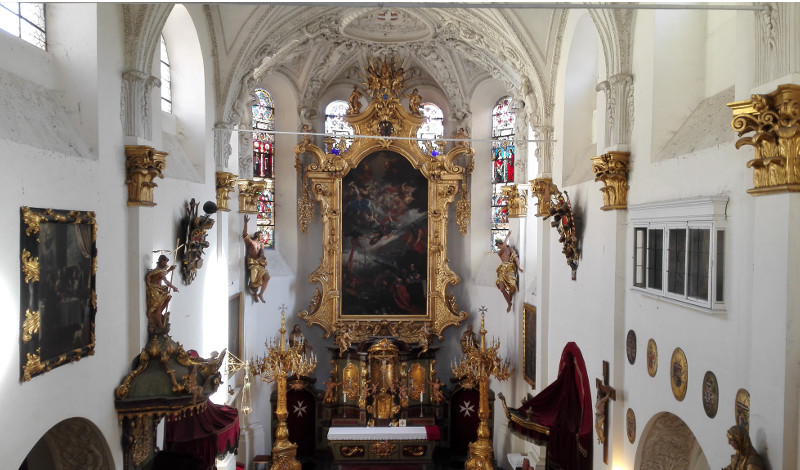
The Church of Our Lady beneath the Chain stands at the heart of the oldest surviving precinct of the Order in the world. In the second half of the 12th century the Knights of St. John built a three-aisled Romanesque basilica here at the foot of the Judith Bridge; its existence is confirmed by a charter of Pope Lucius III dated 23 October 1182. The name “beneath the Chain” is explained either by the chain that closed the gate of the commandery or the bridge at night, or by a chain stretched across the river when tolls were collected.
The building
Gothic rebuilding probably began in the first half of the 14th century: two towers and the choir were built, but the nave was never completed. Today's church is therefore only the choir of the planned Gothic church. The space between the towers and the church is a courtyard where the Order's cemetery once lay, and the arcades of the Romanesque basilica can still be seen on the north wall of the palace. The Gothic porch between the towers dates from around 1400.
After its devastation by the Hussites in 1420 and a fire in 1503 the church was repeatedly restored, and in 1591–1611 it was remodelled in the Renaissance style. It received its early Baroque appearance under Grand Prior Rudolf Count Colloredo-Wallsee: work began in 1645 and, after an interruption caused by the Swedish occupation of the Lesser Town, was completed in 1654–1655 by the builders Santino de Bossi and Carlo Lurago. The vaults are decorated with stucco by Italian stuccoists.
Altars and works of art
The high altar, completed in 1741, holds an altarpiece by Karel Škréta from around 1651. It shows knights of the Order with their Grand Master, above whom the Virgin and Child and St. John the Baptist appear. The fortified tower in the background shows that the scene is the defence of Malta in 1565, not the Battle of Lepanto, as is often said. The sculptures of the high altar and the angels on either side are probably the work of Jan Petr Wenda, whose workshop also made the pulpit.
The church has ten altars. In the chapel of St. John of Nepomuk, where according to tradition the saint was seized in 1393, fragments of Gothic frescoes from the second half of the 13th century survive. The chapel of St. John the Baptist, patron of the Order, has an altarpiece by Anton Stevens von Steinfels from 1660. The oldest painting in the church, from the end of the 16th century, shows the nursing Mother of God with St. Anne and the young St. John the Baptist. The chapel of St. Barbara holds a late work by Karel Škréta, the Beheading of St. Barbara (1671–1674).
Also notable are the marble statue of Grand Prior Rudolf Colloredo-Wallsee by Emanuel Max, set up in the church in 1857, the stained-glass windows of the sanctuary from 1850 and the Baroque organ case of 1720. The church is rich in heraldry and in tombstones of the Order's dignitaries and benefactors; the oldest belongs to Prior Peter, to whom Pope Boniface IX granted the right to pontificals in 1395.
Today
Since 2004 the church has been the church of the Grand Priory, with a rector. Regular services are celebrated here and concerts of sacred and classical music are held. The entrance is from Lázeňská street through the gate between the towers.
Source: Milan M. Buben, Chrám Panny Marie pod řetězem a Velkopřevorský palác. Dějiny a průvodce (The Church of Our Lady beneath the Chain and the Grand Priory Palace: History and Guide), Prague 2026.