
History of the Grand Priory of Bohemia
The Order of St. John was brought to Bohemia by Duke Vladislaus II, who had come to know its work while taking part in the Second Crusade in the army of the German King Conrad III. Some time between 1158 and 1169 (according to the latest research, more probably around 1169) the Knights of St. John received land south of the bishop's court at the bridgehead of the Judith Bridge. The centre of the Order became the Church of Our Lady beneath the Chain; the name recalls either the chain that closed the gate of the commandery or the chain stretched across the river to stop boats and rafts so that tolls could be collected.
Further commanderies were founded over time, the most important at Strakonice, Horažďovice, Manětín and Český Dub. In 1301 Pope Boniface VIII granted the prior of Our Lady beneath the Chain the right to pontificals. In 1378 the body of the late Emperor Charles IV lay in state for a day and a night in the Order's church in Prague. In 1393 the neutral ground of the Order witnessed the ugly scenes in which King Wenceslas IV attacked the Archbishop of Prague, John of Jenštejn; the victim of the king's anger was ultimately the vicar general, John of Nepomuk.
In 1402 the Order became the owner of the whole of Strakonice Castle, which after the Hussites drove the Order from Prague became its refuge and its centre in Bohemia. The priors general there were zealous defenders of the Catholic faith and leading members of the Strakonice and Zelená Hora leagues opposed to King George of Poděbrady. In 1512 Pope Julius II granted the priors of Strakonice the right to pontificals until the Prague convent should be restored. Czech knights also took part, if only in symbolic numbers, in the heroic defence of Malta (1565) and the Battle of Lepanto (1571).
On the eve of the Thirty Years' War the Spanish Carmelite Dominic of Jesus and Mary found at Strakonice a painting of the Virgin and Child that had been desecrated by Protestant soldiers; he carried it before the troops at the Battle of the White Mountain. As the victory was attributed to the Virgin's help, the image came to be venerated as Our Lady of Victory. From 1626 the head of the Order in Bohemia bore the title of Grand Prior; among them, Rudolf Colloredo-Wallsee won fame in 1648 for his heroic defence of Prague against the Swedes.
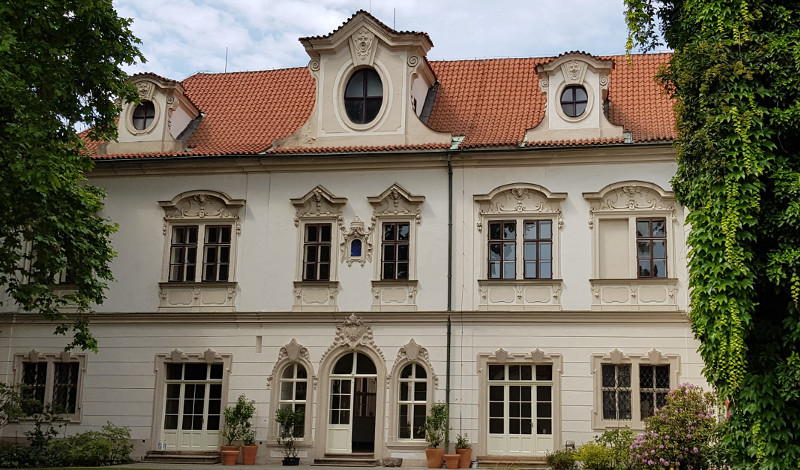
In 1694 the convent returned with the Grand Prior from Strakonice to Prague, where on 22 February 1718 one of the miracles required for the canonisation of John of Nepomuk took place (the rescue of seven-year-old Rosalie Hodánková from under the ice). The residence of the Grand Priors of Prague was built in 1726–1727, and the convent on the other side of the church in 1728–1731. In 1784 the Order was entrusted with the spiritual care of the Church of Our Lady of Victory with its world-famous Infant Jesus of Prague. The Grand Priory of Bohemia, including its convent of priests, was the only one to withstand the general collapse of the Order's structures in the upheavals of the Napoleonic wars and the secularisation of Europe. Grand Prior Othenio Lichnowsky-Werdenberg brought the Order renown by establishing eight hospital trains for the wounded of the First World War; together they covered 1,062,760 km and carried 359,945 wounded from the front. The Order's doctors performed 27,163 operations during the war, more than half of them in the Order's field hospitals. The Grand Priory also financed the building and running of the hospice at Tantur in the Holy Land.
On 2 April 1881 Emperor Francis Joseph I raised the Grand Prior of Bohemia and Austria (and his successors) to the rank of Austrian Prince. After the fall of the monarchy, land reform, the economic crisis and the political climate diminished the Order's property. For political reasons the Grand Priory was divided in 1938 into the Grand Priory of Bohemia and the Grand Priory of Austria. Two figures helped the Order through the difficult years of the Second World War: Karel Cardinal Kašpar, Prince-Archbishop of Prague and Primate of Bohemia, and Karel Prince of Schwarzenberg, who also ensured the survival of the Grand Priory in exile after the Communists suppressed the Order in 1950. The Order's work in Prague was officially restored on 1 April 1990; the restoration was publicly announced on 20 April 1990 at Mass in the Church of Our Lady beneath the Chain, on the eve of Pope John Paul II's visit to Prague.
PhDr. Milan Buben, Ph.D.,
Knight of Magistral Grace