
The ancient Tongues of the Order
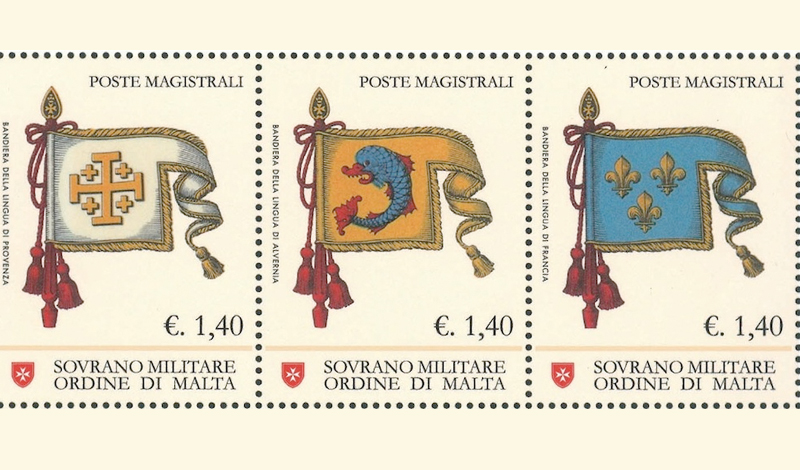
At the beginning of the 14th century, with the acquisition of Rhodes and other islands of the archipelago, the Order of St. John took on the features of a state. Its government, led by the Grand Master and the Council, issued its own coinage and maintained diplomatic relations with other states.
New knights came to Rhodes from all over Europe, and it was natural for them to join those who spoke the same language and shared the same traditions.
The Chapter General of the Order, meeting in Montpellier in 1319, decided to group the Hospitallers into homogeneous language groups, the Tongues. Each Tongue included grand priories or priories, bailiwicks and commanderies.
The Tongues did not follow the pattern of nation states but rather the territorial and linguistic identities of Western Europe.
There were exceptions: the Poles and other Slavs (including the Czechs), for example, belonged to the German Tongue even though they did not speak German.
At first there were seven Tongues in the Order: Provence, Auvergne, France, Italy, Aragon (Navarre), Germany and England. In 1492 Castile and Portugal separated from the Tongue of Aragon to form an eighth Tongue (Castile). Each Tongue had its own head, the pilier, who later held one of the high offices of the Order. On Rhodes and later on Malta every Tongue also had its own auberge, an inn used for lodging, meetings and meals, which, at least at first, had to be taken in common.
This internal organisation of the Knights of St. John was more or less complete by the middle of the 15th century and lasted until the end of the 18th century.
The loss of Malta in 1798 brought the old division into Tongues to an end. The Order began to reorganise, and after it settled in Rome in 1834 national associations were founded: the German knights were the first, in 1859, followed by the British in 1875 and the Italians in 1877. Today the members of the Order belong to the grand priories and national associations, the heirs of the tradition of the ancient Tongues, on five continents.